Showing posts with label Lupine Publishers LLC. Show all posts

Friday, January 24, 2020

Socioeconomic Variables Associated with Level of Obesity and Prevalence of Other Diseases Among Children and Adolescents of Some Affluent Families of Bangladesh| Lupine Publishers

Diabetes and Obesity Open access Journals- Lupine Publishers


Abstract

The present study utilized the data collected from 662 children observed from 560 randomly selected families of students of American International University-Bangladesh. Among the investigated children and adolescents 465 were in underweight group. Obesity and severe obesity were observed among 9.1 percent children and adolescents and prevalence of diabetes was observed among 22.8 percent respondents. The percentage of respondents affected by different diseases except diabetes was 13.4. It was evident that level of obesity, prevalence of diabetes and prevalence of other diseases were significantly associated, and level of obesity was associated with different socioeconomic characters of the parents and of the respondents. Parents’ education, age of children, family income and food habit of the children were the most important variables for the change in level of obesity of children and adolescents. Fitting of logistic regression using level of other diseases as dependent variable showed that residence, parents’ education, family income, prevalence of diabetes, food habit of the children, blood sugar level of children, utilization of time by the children were some of the variables responsible for prevalence of other diseases among the children.
Keywords:Level of obesity; Socioeconomic variables; Significant association between diabetes and level of obesity; Logistic regression

Introduction

Child overweight and obesity are the most serious public health challenges of the 21st century worldwide , specially, in low and middle-income countries. It affects mostly the urban people [1,2]. The obesity for child and adolescents is measured by body mass index [BMI = weight in kg / (height in meter2] , where children having BMI above the 85th percentile are considered as overweight and those who have BMI above the 95th percentile are considered as obese [3]. The level of obesity is increasing at alarming rate. In a global study in 2016 it was estimated that over 41 million [1] children under the age 5 years were overweight. The prevalence of overweight in adolescents is defined by BMI + standard deviation of BMI and obesity for them is decided by BMI + 2 standard deviation [1]. Overweight and obesity are defined as abnormal or excessive fat accumulation that presents a risk to health. Child obesity can lead to life threating conditions including diabetes, heart disease, sleep problems, cancer, liver disease, early puberty, eating disorders, skin infection, asthma and other respiratory problems [4]. The adolescent’s obesity leads to the problem of hepatitis, sleep aponia, and increased intercranial pressure [5].
The other effects of overweight and obesity are psychological [6], depression [7], physical [8,9]. The early physical effect of obesity in adolescence is noted when it affects all most all the organ which leads to the increase rate of mortality in adulthood [4,10]. The causes of childhood obesity are genetic. Over 200 genes affect weight by determining activity level, food preferences, body type, and metabolism [4]. Family practices such as decreasing rate of breast feed, by mothers, stay home and utilizes electronic devices, less physical activity, food habit, specially, taking more calorie food from restaurant with less fiber [4,9,11], low socioeconomic status [12], eating habit of calorie- rich drinks [13]. However, the problem can be obviated by avoiding the sources of causes of obesity and encouraging the children and adolescents to be involved in physical activities. From the above discussion, it can be concluded that growing level of obesity among children and youth and increasing the rate of prevalence of diabetes are of great concern throughout the world. Many of the complications are silent and often go undiagnosed. The obese children are at high risk for the development of early morbidity. Considering all these aspects discussed above, the objective of the study was planned to observe the joint relationship of level of obesity and prevalence of diabetes including prevalence of other diseases with other socioeconomic factors which were more responsible for the variation in the level of obesity among children and adolescents under 18 years of age coming out from affluent families. The specific objective was to investigate the association of level of obesity of children and adolescents with some social factors. Also, to identify the responsible variable for other diseases.

Methodology

For the analysis it was decided to collect information from children of affluent families. In a separate [14,15] families of students of American International University - Bangladesh were identified as affluent families. Hence, it was planes to collect data from some randomly selected families of students of the abovementioned university. In a previous study [16] it was reported that there were 7% overweight and obese children and youth in Bangladesh. Accordingly, we had decided to have a proportion of at least 7% overweight and obese children and youth with margin of error of 2% at 95% confidence. Accordingly, for a simple random sample the sample the calculated value of sample size was an=625. This sample size covered 6.6% students of the university. The sample students were selected by simple random sampling method and were expecting at least responses from 5% families of the students. However, information was received from 560 families, covering the data of 662 children.
The data were collected through pre-designed and pre-tested printed questionnaire covering the questions related to the demographic characteristics of the children and adolescents of age below 18 years and the questions related to the socioeconomic variables of the parents. The randomly selected students were given written instructions how to collect information and they were requested to help in collecting information from their parents, who were very much concerned about the health hazard of their offspring. The parents of children filled in the questionnaires as some of the children were under 18 years of age and some were even below 10 years. The important collected information was age, height, weight, sex, food habit, time spent, involvement in co-curricular activities, if it is feasible, of the children, and information regarding the prevalence of any other diseases. To study the socioeconomic background of the children, the information regarding parent’s level of education, occupation and income were also collected. For youth having diabetes, the latest blood sugar level measured by registered practitioner or measured in a registered clinic also recorded. Association of level of obesity of offspring with families’ socioeconomic background were examined using chi-square test, where significant association was concluded when p-value ≤0.05. Logistic regression model using levels of prevalence of other diseases as dependent variable was fitted.

Result and Discussion

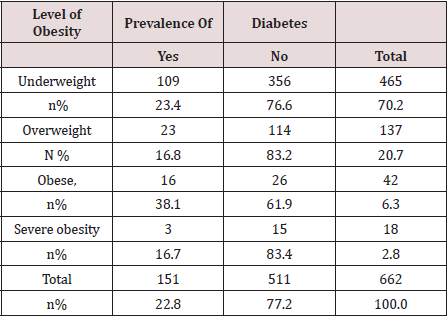
The present analysis was done using the data of social, medical and economic aspects of 662 children of age less than or equal to 18 years investigated from 560 randomly selected families of the students of American International University – Bangladesh. From the analysis it was noted that 22.8 percent children were affected by diabetes. This percentage among the obese and severe obese group of children was 32.2 indicating that level of obesity and prevalence of diabetes was significantly associated
[ χ2 =8.741, p-value = 0.033, Table 1]
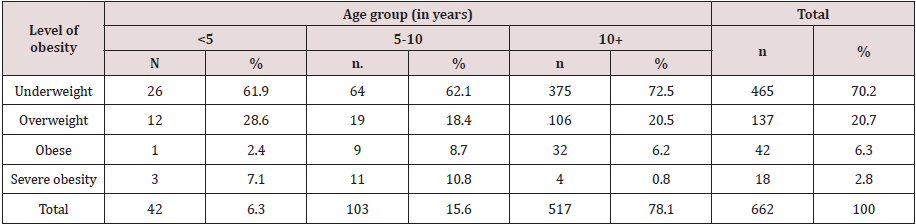
Considering the prevalence of diabetes among the obese and severe obese group compared to non-obese group, the former group were 69 percent more exposed to the problem of diabetes [O.R = 1.69]. Their risk ratio was 1.47 compared to non-obese group. Amongst the investigated children 70.2 percent were in underweight group and 9.1 percent were in obese and severe obese group. The level of obesity was measured by the amount of BMI (weight in kg / height in m2). The mean value of BMI was 17.67 with a standard deviation 10.58. The underweight group of children and adolescents had BMI <23. The BMI of other three groups were 23 - <30, 30 - <45 and 45+. The levels of BMI were decided according to the percentile values. This finding was almost similar to that observed in another study [15]. Amongst the observed children and adolescent’s 78.1 percent were in the age group 10 years and above and 70.2 percent of the investigated children and youth were in underweight group and 9.1 percent were obese and severely obese. Majority [ Table 2, 78.2%] of them were in the age group 10 years and above and among them 72.6 percent were in underweight group. In these group obese and severe obese children were 6.9 percent. Major obese and severe obese children (19.4%) were among the children of age 5 to less than 10 years. The differences in the proportions of levels of obesity according to different age groups were significant [ χ2 = 39.043, p- value = 0.000]. The prevalence of obesity and severe obesity among the children of age group 5 to less than 10 years compared to children of other age groups were too high [O.R = 13.06]. Let us investigate the prevalence of diabetes and prevalence of other diseases among the children and adolescents. It was observed that 86.6 percent investigated children had no other health hazard (Table 2) except diabetes. However, 21.2 percent of them were diabetic patients. Among the diabetic patient’s 11.3 percent had eye problem. The major problem among the respondents was eye problem. The percentage of this group of children was 7.6. There were significant differences in the percentages of respondents facing health hazard according to prevalence of diabetes [χ2 = 10.957, p-value = 0.027].
Table 1: Distribution of respondents according to level of obesity and prevalence of diabetes.
lupinepublishers-openaccess-journal-diabetes-obesity
Table 2: Distribution of children according to prevalence of diabetes and prevalence of other diseases.

lupinepublishers-openaccess-journal-diabetes-obesity
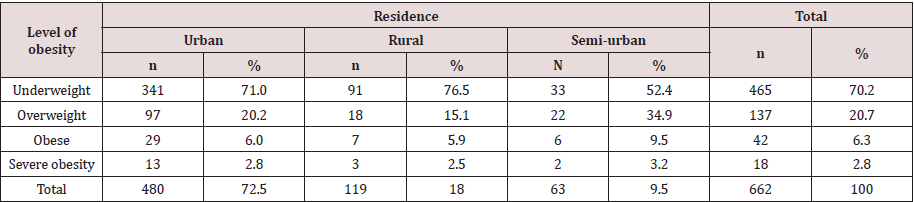
Now, let us investigate the reason of obesity and severe obesity among the children and youth. Some of the social factors might have enhanced the level of obesity. This was noted from the study of association of different factors and level of obesity. The investigated children and adolescents were classified into three classes by their age levels. These three groups of children were again classified by their level of obesity. The classified results were shown in Table 3. It was seen that 72.5% children and youth of the age group 10 years and above were underweight. The proportions of underweight children of other two age groups were lesser than the percentages of overall underweight group of children. The children less than 5 years of age had the highest percentage of the overweight group and this group of children had the 58 percent [O.R.=1.58] more chance of overweight compared to other groups of children. This differential in proportions of level of obesity according to age groups was highly significant [ χ2 = 38.94, p-value=0.000]. Amongst the studied children 58.2 percent were males (Table 4) and 77.4 percent of them were underweight. The corresponding figure among females is 60.3 percent. The differential in obesity by sex differences is significant [ χ2= 44.03, p-value= 0.00]. Number of children of different levels of obesity belonging to different residential areas were presented in (Table 5). It was seen that maximum village children (76.5%) were underweight compared to urban semiurban children. Again, among the village children, number of obese and severe obese groups were lower compared to other groups of children. The differences in proportion. The information of 72.5% children were reported from urban area. The corresponding percentages of rural and semi-urban children were 18 and 9.5. The classified information of level of obesity and residence of children were significantly different [ χ2 = 12.45, p-value= 0.04]. Similar findings were observed in other studies [14,15] It was already mentioned that the study group of children were mostly living in city center (72.5%) and though they had the enough scope to be involved in physical activities like games and sports, still majority of the children (39.9%) passed their time by watching television and 16.8% slept after or before their academic activities. One-fourth (26.4%) of the investigated children mentioned that they were involved in some other activities including games and sports (Table 6). Around 72% severe obese group killed their time by watching television. The corresponding percentage among obese group is 45.2. The differentials in proportions of utilization of time by the children of different obese groups were significantly different as [χ2= 54.12 with p- value = 0.00]. Let us now observe the food habit of investigated children and adolescent. As the investigating units were mostly from affluent city residence, they had the scope to get sufficient foods, with proper hygienic measures. Among the investigating units’ 47.9 percent were habituated in taking food from restaurants. Among the obese children 54.7 percent were habituated in takin restaurant food (Table 7).
Table 3: Distribution of children and adolescents according to their age and level of obesity.
lupinepublishers-openaccess-journal-diabetes-obesity
Table 4: Distribution of children according to their gender and level of obesity.
lupinepublishers-openaccess-journal-diabetes-obesity
Table 5: Distribution of children according to their residence and level of obesity.
lupinepublishers-openaccess-journal-diabetes-obesity
Table 6: Distribution of children according to their utilization of time and level of obesity.

For more Lupine Publishers Open access journals please visit our website
For more Diabetes open access journal please click here

Sunday, June 9, 2019

Diabetes open access journals- Lupine Publishers


Background: Hand-grip strength (HGS) has been shown recently to help in predicting disease outcomes and assessing health risk, particularly in cardiovascular and metabolic disease. Studies confirming its link to diabetes (T2DM) suggest there is potential for its use as simple screening tool. This study examined this possibility in a developing-world population, in a cohort of Tongan diabetics.

Methods: HGS was measured in a randomly selected cohort of patients, comprising in total 149 patients, of which 91 with and 58 without T2DM. Other measurements recorded included patient demographics, blood pressure and date of diabetes diagnosis.

Results: HGS was found to reduce significantly with age in all groups and it also related to BMI in males. Binary logistics regression models were produced using ‘HGS,’ ‘Age’ and ‘BMI’ which had a sensitivity of 82-84% (M/F) and specificity of 50-57%.

Conclusion: This study uses one of the well-known effects and complications of T2DM, affected hand grip strength of sufferers, as a parameter in a ‘tool’ to predict the presence of the disease showing very good sensitivity. Further research is needed into the more general utility of the tool, while further work may help identify among the diagnosed those who would benefit from specialist treatment.

For more Information click on below link

For more Diabetes open access journal articles click on below link

To know more about Lupine Publishers click on below link


Monday, May 27, 2019

Obesity Journal- Lupine Publishers


Background: Malnutrition is a major public health concern that frequently tends to be unrecognized and untreated. About 1/3 of all patients in the hospital are undernourished globally. Malnutrition is significantly more common in older adults, and consequently they are in danger of suffering from malnutrition prior to their admission.

Aim: The objectives of the present study were to estimate the prevalence and severity of malnutrition, along with recent weight loss, in older adults admitted to a department of internal medicine in public general hospital in Greece. Methods: Data was collected from a total sample of 127 patients (>65 years old) recruited from the patients admitted to an internal medicine ward by conducting a cross-sectional study. Nutritional status was assessed by using the Mini Nutritional Assessment - Short Form (MNA-SF).

Results: The median age of participants was 78 (SD 7.2 years), and among them, 61.4% were women. The prevalence of malnutrition in the hospitalized older patients was 19.7%. According to MNA-SF, 52.7% of older patients were at risk of malnutrition, and among them, 27.6% had decreased food intake during the last three months. During the last three months, 19.7% experienced an unintentional weight loss more than three kg. Additionally, 15% of participants with a Body Mass Index (BMI) over 23 kg/ m2 were classified as malnourished, and only 33% of them were classified with no nutritional problem (p=0.003). Among the 25 malnourished older patients identified by MNA-SF, only 8 were prescribed Oral Nutritional Supplements (O.N.S).

Conclusion: The high prevalence of malnourished patients and older patients at risk of malnutrition emphasizes the need for hospitals to adopt a particular policy and a specific set of clinical protocols to identify patients at nutritional risk leading to an appropriate nutritional care plan. Early identification by a validated screening tool, could lead to an effective management of malnutrition.

For more information click on below link

For more Obesity Journal articles click on below link

For more Lupine Publishers click on below link

Tuesday, April 30, 2019

What is the role of Editors in Lupine Publishers?

What is the role of Editors in Lupine Publishers? 

Editor Guidelines

The main epigram of Lupine Publishers is to spread scientific knowledge globally by publishing quality articles in their open access journals. The credibility of published articles completely depends on the effective peer review process; Hence, editors are the chief support for Lupine Publishers. The Editorial board members of Lupine are responsible to make it as quality manuscript publisher which are received from authors on various subject areas.
Roles and Responsibilities:
  • Actively look for the views of associate editors, authors, readers, reviewers and editorial board members about ways of improving their journal's content.
  • Reputation of our group is enhanced by the presence of eminent editors. They also must endeavor to set higher standards for the journal whenever possible.
  • Sustain initiatives to educate researchers and young scholars about publication policies and ethics.
  • Editorial board members are most welcome to give their valuable suggestions for organizational progress.
  • Editors can review submitted manuscripts based on their feasible time, if time does not allow reviewing the manuscript, editors can suggest other reviewers.
  • Editors will look after any confidential data regarding the task. If the author has used information of certain individuals, specifically in any of his medical or scientific records, the editorial Team must look for written consent from the individual, for the record to qualify for publishing.
  • Grabbing editorial decisions at the right time and communicating in a clear manner.
  • The validity of the scientific facts stated must be checked and the criticism of the manuscript should be left open for all to decide.
  • The editorial board members must assure that published content is original. The reliability of the author's work is a must, so there must be proper citation and the original source of the content should be named.
  • The final decision regarding modification, acceptance, or rejection of a manuscript rests solely with the editor.
Benefits:
  • Editors can be promoted as senior editor and executive editor in the concerned journal based on their active participation and also based on their experience.
  • Editors will be given highest priority in all the events that are organized by Biomedical Journal.
  • Based on their kind contributions and their efficiency, there is a chance to serve as a prominent member of the advisory board.
  • After one year of due course, Editor-in-Chief will be announced for every journal based on their active participation, expertise in the field, contribution towards the Journal and also their scientific contributions.
  • The review comments that are given by the editors will be strictly followed after which the authors will be requested to modify their manuscript according to the editor’s suggestions.
  • We promote all the articles of the Editors that are published in our journals, in various social networking groups from our end, increasing visibility for their works.
  • Our journals consider Editorials as a note to the young researchers and scholars.
  • Editors shall be honored in position as Chair/Co-Chair for any conferences organized by us and also the fee will be waived.

https://www.quora.com/What-is-the-role-of-Editors-in-Lupine-Publishers

Lupine publishers LLC | Lupine Publishers Review

Lupine publishers LLC | Lupine Publishers Review


Lupine Publishers LLC isa world’s leading Online Publishing repository, a genuine publisher with quality medical journals. Lupine Publishers LLC peer reviewed publisher is a multidisciplinary, scholarly Open Access publisher focused on Genetic, Biomedical and Remedial missions in relation with Technical Knowledge as well. Lupine Publishers LLC Online Open Access Publisher,craves to select ground- breaking research based on modernism, aptness, scientific connotation, prospective spectator’s interests, setc. Lupine Publishers LLC Online Open Access Publisher endeavor to provide by far and liberally accessible belvedere to researchers and practitioners in support of their novel and valuable ideas. Lupine Publishers LLCOnline Open Access Publisher already have 2000+ Editorial Board members along with 5000+ Published articles with them. Lupine Publishers LLC Online Open Access journals maintains a scrupulous, methodical, fair peer review System. Besides, quality control is riveted in each step of the publication process.Lupine Publishers LLC, strictly follows open access policy: Open access policies are part of rapidly growing researches in academia to enhance and encourage the new modes and techniques of scholarly publication by providing worldwide free access. Members of universities, schools and departments are establishing open access policies to make their research and scholarship more accessible to scholars, educators, policymakers, students and citizens worldwide. The only motto of Lupine Publishers LLC Open access Publisher is accelerating the scientific and technical research papers,considering the importance of technology and the human health in the advanced levels and several emergency medical and clinical issues associated with it, the key attention is given towards biomedical research. Thus, Lupine Publishers LLC asserting the requirement of a common evoked and enriched information sharing platform for the craving readers. Lupine Publishers LLC is such a unique platform to accumulate and publicize scientific knowledge on science and related discipline. Lupine Publishers LLC multidisciplinary open access publisher is rendering a global podium for the professors, academicians, researchers and students of the relevant disciplines to share their scientific excellence in the form of an original research article, review article, case reports, short communication, e-books, video articles, etc. Lupine Publishers LLC has quality journals which are self supporting, with no dependency on any other external sources (like universities, centers) for funds and strives for the best and enhanced quality publications competes the world wide open access publishing market. Lupine Publishers LLC always rely on the support from the members of the Lupine Publishers LLC family that is relevantly their Authors, Editorial Committee members, advisory board, Reviewers Board and all the technical support teams all over the globe. Lupine Publishers LLC trust in the reciprocated coordination and cooperation in terms of sharing the scientific knowledge of individuals and Groups of Research centers/areas will in turn educates and provokes in advanced researches. In this case Lupine Publishers LLC like to act as a media that anchors in the transformation of information in the form of global online publication.

Monday, April 29, 2019

Journal of Diabetes Research- Lupine Publishers

Background: Malnutrition is a major public health concern that frequently tends to be unrecognized and untreated. About 1/3 of all patients in the hospital are undernourished globally. Malnutrition is significantly more common in older adults, and consequently they are in danger of suffering from malnutrition prior to their admission.
Aim: The objectives of the present study were to estimate the prevalence and severity of malnutrition, along with recent weight loss, in older adults admitted to a department of internal medicine in public general hospital in Greece. Methods: Data was collected from a total sample of 127 patients (>65 years old) recruited from the patients admitted to an internal medicine ward by conducting a cross-sectional study. Nutritional status was assessed by using the Mini Nutritional Assessment - Short Form (MNA-SF).
Results: The median age of participants was 78 (SD 7.2 years), and among them, 61.4% were women. The prevalence of malnutrition in the hospitalized older patients was 19.7%. According to MNA-SF, 52.7% of older patients were at risk of malnutrition, and among them, 27.6% had decreased food intake during the last three months. During the last three months, 19.7% experienced an unintentional weight loss more than three kg. Additionally, 15% of participants with a Body Mass Index (BMI) over 23 kg/ m2 were classified as malnourished, and only 33% of them were classified with no nutritional problem (p=0.003). Among the 25 malnourished older patients identified by MNA-SF, only 8 were prescribed Oral Nutritional Supplements (O.N.S).
Conclusion: The high prevalence of malnourished patients and older patients at risk of malnutrition emphasizes the need for hospitals to adopt a particular policy and a specific set of clinical protocols to identify patients at nutritional risk leading to an appropriate nutritional care plan. Early identification by a validated screening tool, could lead to an effective management of malnutrition.


For more Lupine Publishers Open access journals please visit our website
For more Journal of Diabetes Research please click here


Monday, March 25, 2019

Journal of Diabetes Research Impact Factor- Lupine Publishers


Background and Objective
The association between diabetes and thyroid dysfunction were studied. To estimate retrospectively the frequency of hypothyroidism in patients with type 2 diabetes (T2DM) in Saudi community-based hospital.
Design
We analyzed retrospectively 3760 participants whom are between the age 20 to 98 years. All patients were from the population of the Primary health centre at King Fahad Armed Forces Hospital, Jeddah, Saudi Arabia. All data were collected on the basis of a review of electronic medical data. Patients with TSH above the normal range of TSH for our laboratory reference (4.2 MIU/L, history of hypothyroidism and taking thyroid replacement therapy were included. Patient who are pregnant were excluded.
Results
Out of the initial screening of 6023 subjects, 3760 subjects were included. There were 861 (22.9%) male and 2899 (77.1%) were female with mean age 44.9±15.8. The mean TSH value was 4.3±8.1. Among them we found 1521 (40.7%) and 1086 (28.9%) cases with T2DM and hypothyroidism respectively. Among cases of T2DM, there were 467 (30.7%) with hypothyroidism. There were 86 (18.4%) cases were male and 381 (81.6%) were female with male to female ratio of 1 to 4.4, p< 0.0001. Cases with hypothyroidism were non significantly older than cases with no hypothyroidism, 55.2±12.6 vs. 54.9±13.2 respectively, p=0.6. Cases with hypothyroidism were non significantly showed no differences in HbA1c than cases with no hypothyroidism, 7.9±2.3 vs. 8.1±2.1 respectively, p=0.2. Hypothyroidism was more prevalent in the sixth decade (32%), figure 1. Hypothyroidism was significantly more prevalent in females between the third to the seventh decades as compared to males. Male was no significantly more prevalent than females in the eighth and ninth decades.
Conclusion
We conclude that despite the limitations of this hospital-based retrospective study, hypothyroidism is highly prevalent in cohort of Saudis with T2DM. The majority of our patients with primary hypothyroidism were predominantly females. These two observations remain to be validated by population-based studies. In the absence of registry data, larger cooperative studies involving diverse population samples from multiple centers could help to provide further information on the true frequency nationally. Based on a high prevalence of hypothyroidism among Saudi T2DM patients, routine screening for hypothyroidism is highly recommended in Saudi diabetic population.


For more Lupine Publishers Open access journals please visit our website
For more Diabetes Research Impact Factor please click here

Wednesday, March 6, 2019

Obesity Research Articles- Lupine Publishers


Management of Postprandial Blood Glucose in Diabetes Mellitus by Poondy Gopalratnam Raman in Archives of Diabetes & Obesity in Lupine Publishers

Patients with type-2 diabetes have more than half the day in the post meal state. Elevation in post meal plasma glucose is due to loss of first phase insulin secretion, decreased insulin sensitivity in peripheral tissues and consequent decreased suppression of hepatic glucose output after meals due to insulin deficiency. Elevated or exaggerated post meal response is directly responsible for endothelial dysfunction and pro-atherogenic states. Post-meal hyperglycemia is a prominent early defect in type-2 diabetes patients.


Monday, February 25, 2019

Obesity Research Journal- Lupine Publishers


Diabetes Mellitus is a chronic disorder characterized by hyperglycemia due to insulin deficiency or insulin resistance. There is no permanent cure for Diabetes. Only way is to replace insulin producing beta-cells. Whole pancreatic transplantation and purified pancreatic islets transplantation are the answer to cure for diabetes. But scarcity of suitable donor and morbidity, high cost involved are limiting factors for pancreatic transplantation. Islet cell transplantation is less invasive procedure and safer than total pancreatic transplantation established in year 2000. Isolated islets carry less antigenic property.


For more Lupine publishers open access journals please visit our website

For more Obesity Research Journal please click here

Monday, February 18, 2019

Obesity Journal- Lupine Publishers


Since 2010, the American Diabetes Association has endorsed both HbA1C (A1C) and fasting plasma glucose (FPG) to determine diabetes risk. Given the discordance between classifications based on FPG and A1C and higher A1C levels among African Americans (AAs) than whites, we sought to examine the prevalence of normoglycemia, prediabetes, and diabetes among a community sample of adult AAs (n=704) screened for enrollment in a randomized Diabetes Prevention Program (DPP). We conducted a retrospective analysis to estimate the degree of discordance between risk categories based on FPG and A1C and examine the risk factors that predicted A1C and FPG levels. To determine differential effects on risk categories defined using FPG and A1C, we examined the effects of the program on the measures at 12 weeks post-intervention among the intervention arm participants.

The tests revealed different prevalence levels at baseline: A1C, 36.2% normoglycemia, 52% prediabetes and 11.8% diabetes; FPG, 81.1%, 16.8%, and 2%, respectively. There was discordance among A1C and FPG and among the risk categories (p<0.001). Both final regression models included age and waist circumference as predictors. For FPG, additional predictors were family history of diabetes and male gender. Post intervention, only those classified in the prediabetes category defined in terms of either test demonstrated intervention effects. Screening test choice results in different sample composition; both A1C and FPG respond to intervention effects among individuals classified in the prediabetes group only. These results have implications for research and clinical practice.


For more Lupine publishers open access journals please visit our website

For more Obesity Journal please click here


Monday, February 11, 2019

Diabetes Journals- Lupine Publishers


Low grade inflammatory condition which is predominately cytokine-mediated is observed to be closely involved in the pathogenesis of type 2 diabetes as well as role this inflammatory condition cannot be ruled out in involvement in pathogenesis of type 1 diabetes. Since maximum world populations are at high risk of developing diabetes, we tested this hypothesis by estimating circulating acute phase proteins in freshly diagnosed type 2 (T-2) as well as type1(T-1) diabetic patients.

The acute phase proteins, α1- antitrypsin, α1- acid glycoprotein, ceruloplasmin and fibrinogen were estimated in the plasma in freshly diagnosed twenty-five T-2 cases and twelve T-1cases. Thirty normal controls to match the age and sex of the test groups were also studied. The levels of these proteins were correlated with their BMI and random plasma glucose values.


In comparison with the controls, the values of all the four proteins studied were significantly elevated in the T-2 patients (p<00001). In case of T-1 patient level of ceruloplasmin and fibrinogen are significantly elevated. Interestingly, no correlation was found with BMI or the degree of hyperglycemia in either of the types. A low-grade inflammatory process is definitely implicated in the pathogenesis of type 2 diabetes. Same can be ruled out in type-1 diabetic patients also. The comparative study of the states of all these inflammatory markers in case of T-2 and T-1 patients is of interest in this present study.


For more Lupine publishers open access journals please visit our website


For more Diabetes Journals please click here

Monday, February 4, 2019

Diabetes and Obesity Journals- Lupine Publishers


Just the other day, I wrote an Editorial for another journal on World Diabetes Day. Before that, it was the World Thrombosis Day. Think of just metabolic diseases, you have, - World Hypertension Day (May 17), World Obesity Day (Oct 11), World Heart Day (Sept 29), World Thrombosis Day (Oct 13), World Diabetes Day (Nov 14). The list keeps growing every year. Whenever I am asked to participate, in these World Observation Days or asked to write about these important annual days, I ask myself, what have we done to arrest, reduce or prevent these chronic metabolic diseases? What can be done about the raising epidemics of chronic diseases? These are hard questions to ask? Much harder, to answer.

All that we can do is, just like we do for New Year’s Day, take a pledge to do something that will make a difference. Metabolicdiseases, such as hypertension, excess weight, obesity, type-2 diabetes, and vascular diseases, have reached epidemic proportions worldwide. In the last three decades globally, obesity has increased two-fold and diabetes, four-fold. No country has stopped, reversed or prevented the trends, in the increase of these chronic metabolic diseases. We and others are of the opinion, that if the metabolic risks are recognized earlier, then just lifestyle modifications may be enough to prevent or postpone the development of diabetes and associated chronic clinical complications.


For more Lupine publishers open access journals please visit our website

For more Diabetes research articles please click here
https://lupinepublishers.com/diabetes-obesity-journal/


Lupine Publishers| Semaglutide versus liraglutide for treatment of obesity

  Lupine Publishers| Journal of Diabetes and Obesity Abstract Background: Once weekly (OW) semaglutide is a glucagon-like peptide...