Monday, September 7, 2020

Lupine Publishers| Bromocriptine - A Novel Therapy in Type-2 Diabetes

Lupine Publishers| Bromocriptine - A Novel Therapy in Type-2 Diabetes


Lupine Publishers| Archives of Diabetes and Obesity


Abstract

Bromocriptine is used in treatment of diabetes mellitus. It acts by increasing dopaminergic activity in hypothalamus and lowers HbA1c by 0.6 to 0.9%. It is not to be used in type 1 diabetes and DKA.

Keywords:Bromocriptine; Hypothalamus; Contra indicators; Infarction; Combination therapy; Quick release bromocriptine

Introduction

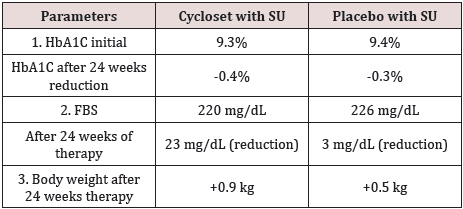
Bromocriptine mesylate is a new modality of treatment for type-2 diabetes. The drug increases dopaminergic activity in the hypothalamus. It lowers HbA1c by 0.6 to 0.9% compared to placebo when added to other oral anti-diabetic agents. It regulates metabolic rhythm. The drug increases insulin sensitivity [1]. There is 24% increase in insulin mediated glucose disposal. Reduces fasting and post prandial hyper insulinemia by 30-70%. Body fat stores and insulin action are controlled by temporal interactions of circadian neuro-endocrine oscillations. Bromocriptine modulates neurotransmeter action in the brain and has been shown to improve glucose tolerance and insulin resistance in obesity and diabetes. Bromocriptine improves glycemic control and glucose tolerance in obese type-2 DM. Both fasting and post prandial blood glucose are reduced. This is due to enhanced maximally stimulated insulin mediated glucose disposal [2]. No change in body weight or BMI occurred with this therapy. Mechanism of Action is unclear. It resets the circadian rhythm at hypothalamic level [3,4]. Preclinical data suggest that decreased hypothalamic dopaminergic tone may be involved in the pathogenesis of insulin resistance. The normal circadian cycle that results in a leaner body in the summer and heavier body in winter is disrupted in humans because of abundant caloric intake year-round resulting in the absence of a lean phase. Stimulation of the hypothalamus promotes the release of several hormones that respond to the traditional shift in caloric intake and storage. Quick-release bromocriptine (D2 against), given once in the morning, stimulates the hypothalamus to release cortisol, growth hormone, and prolactin, allowing a reset of the circadian clock permanently stuck in a winter rhythm. This means there occurs resetting of abnormally elevated hypothalamic drive for increased plasma glucose, triglyceride and free fatty acid levels in fasting and postprandial states in insulin-resistant patients. Other mechanisms, including α-1 antagonist, α-2 agonist, and serotonin and prolactin modulator, may also help to explain bromocriptine’s glucose-lowering effects (Table 1). Bromocriptine quick release (Cycloset) was added on to various antidiabetic agents and studied for 52 weeks safety trial and was found to be useful as add on therapy [4].

Table 1: 24 weeks trial (245) subjects with type-2 diabetes (summary) [3].
lupinepublishers-openaccess-journal-diabetes-obesity

Dosage

To be given within 2 hours are waking with food. Starting dose is 0.8 mg. Recommended dose is 1.6 to 4.8 mg.

Side Effects

Can cause nausea. Taking with food minimise nausea. Can produce hypotension, somnolence, headache, fatigue, vomiting, diarrhea, constipation and dizziness. Loss of consciousness during migraine may reflect dopamine receptor hypersensitivity [5,6].

Contraindications [5,6]

a. Hypersensitivity to Ergot

b. Syncope is potentiated

c. Inhibits lactation, hence, not to be given in lactating mothers

d. Type-I DM or diabetic ketoacidosis

e. Not to be given during pregnancy

f. Syncopal migraine

Interaction [5,6]

Interact with dopamine receptor antagonist, clozapine, olanzapine and reduces the effectiveness. Increases serum levels of Salycilates, Sulfonamide, Chloramphenicol and Probenecid due to its high protein binding character. Avoid using concomitantly with other Dopamine antagonist such as neuroleptics. They diminish the effectiveness of Bromocriptine.

Storage

Store at 25°C and protect from light and moisture.

Conclusion

Bromocriptine mesylate is indicated as an adjunct to diet and exercise to improve glycemic control in adults with type-2 diabetes mellitus. It may be used as monotherapy or as adjunctive therapy to metformin/sulfonylurea. It should not be used to treat type-1 diabetes or diabetic ketoacidosis.


For more Lupine Publishers Open Access Journals Please visit our website:
http://lupinepublishers.us/


For more Open Access Journal on diabetes and Obesity articles Please Click Here:
https://lupinepublishers.com/diabetes-obesity-journal/

To Know More About Open Access Publishers Please Click on Lupine Publishers

Follow on Linkedin : https://www.linkedin.com/company/lupinepublishers

Follow on Twitter   :  https://twitter.com/lupine_online

Lupine Publishers| Crunchbase


Lupine Publishers: Lupine Publishers | We Hear With our Brain as the ...

Lupine Publishers: Lupine Publishers | We Hear With our Brain as the ...:  Lupine Publishers | Journal of Otolaryngology Abstract There are some studies whi...

Friday, September 4, 2020

Thursday, September 3, 2020

Lupine Publishers| Archives of Diabetes and Obesity

Lupine Publishers- Carbohydrates for Diabetes?


Opinion
Would you like a piece of bakes potatoes? NOOOO, I am Diabetic. An answer that we usually face with people with Diabetes Type Two. And mostly whenever we ask them who told you that you are not allowed to eat carbohydrates, the answer is our Endocrinologist! As Clinical Dietitian, I am facing this case on daily basis average. Now, let me tell you that this is not the way. Diabetes type two diets should contain 45-50% of Carbohydrates Does this mean that 50% of my food can be from chocolates and candies? Neither this is the case. Another question to be added: Does this diet help with Obesity? The answer is YES! There are a lot of weight loss diets that are rounding in the field these days. As per my experience, the Diabetes Diet is the only diet that help in weight loss and in the same time to be continued as a healthy lifestyle. (NOTE: in case no other health complications and other Therapeutic diets to be followed).

For a 2000 kcal daily intake, this balanced diet consists of
a) Carbohydrates (45-50%): an average of 8 servings of Carbohydrates per day coming from whole grains, 4 servings of fruits ,6 servings of vegetables and 2 servings of low-fat milk. These foods are good source of vitamins, minerals, dietary fibers and energy.

b) Proteins (10- 20%): an average of 8 servings of Meat of which 80% coming from Lean protein like cottage cheese, skinless chicken) and plant-based sources like legumes (noting that legumes have carbohydrates along with proteins to be counted and managed).

c) Fats (25-35% ): these fats on average of 5 servings where trans-fat (like margarines and spreadable ) should be eliminated and saturated fats to be less than 7% (like chicken skin) and the best sources to come from raw olive oil , nuts and fish to be taken three times per week to get the needed Omega

d) Alcohol: one to two drinks per day, 15 to 30 g of alcohol are associated with decreased risk of coronary heart disease. However, these to be considered an addition to the regular food and manage Carbohydrates servings instead.

So, having Breakfast, Lunch, Dinner and two snacks between the three meals will help to keep a balanced diet and full throughout the day with adequate amounts of liquids to stay hydrated. Now, how can I manage Obesity with this diet? Starting with the Total Energy Expenditure, we start by reducing the Energy Intake by 500 kcal per day. As a result, losing 2.2 pounds per week or 9 pounds per month as an average. Although usually as start of this diet and changing the lifestyle into healthier one and quitting bad habits, we see more weight loss in less time. Along with time, and when weight loss takes place, the Energy Expenditure of the body decreases. And the body gets accustomed to the amount of Energy Intake. In this case, we continue the Energy Intake reduction, so the weight loss continues! Adding physical activity is a big benefit that will help in weight loss and later body weight maintenance. When Diabetes type two can be managed by Diet, why to suffer from its short- or long-term complications? Why to take medications and suffer their side effects when you can manage it by healthy lifestyle! Stay Healthy and Happier.

NOTE: Diet is always customized as per every person’s case.

For more Lupine Publishers Open Access Journals Please visit our website:
http://lupinepublishers.us/

For more Open Access Journal on diabetes and Obesity articles Please Click Here:
https://lupinepublishers.com/diabetes-obesity-journal/

To Know More About Open Access Publishers Please Click on Lupine Publishers

Follow on Twitter   :  https://twitter.com/lupine_online

Follow on Blogger : https://lupinepublishers.blogspot.com/


Lupine Publishers: Lupine Publishers | Primary Determinant in Quality...

Lupine Publishers: Lupine Publishers | Primary Determinant in Quality...:        Lupine Publishers | Current Investigations in Agriculture and Current Research Abstract This study was primarily undertaken to rev...

Sunday, August 30, 2020

Lupine Publishers| Semaglutide versus liraglutide for treatment of obesity

  Lupine Publishers| Journal of Diabetes and Obesity Abstract Background: Once weekly (OW) semaglutide is a glucagon-like peptide...